
The Song Became a QR Code. Its Provenance Survived
What happens to provenance when audio stops being audio? We decided to find out.
A few days ago, we came across one of the most fun audio experiments we've seen in a while.
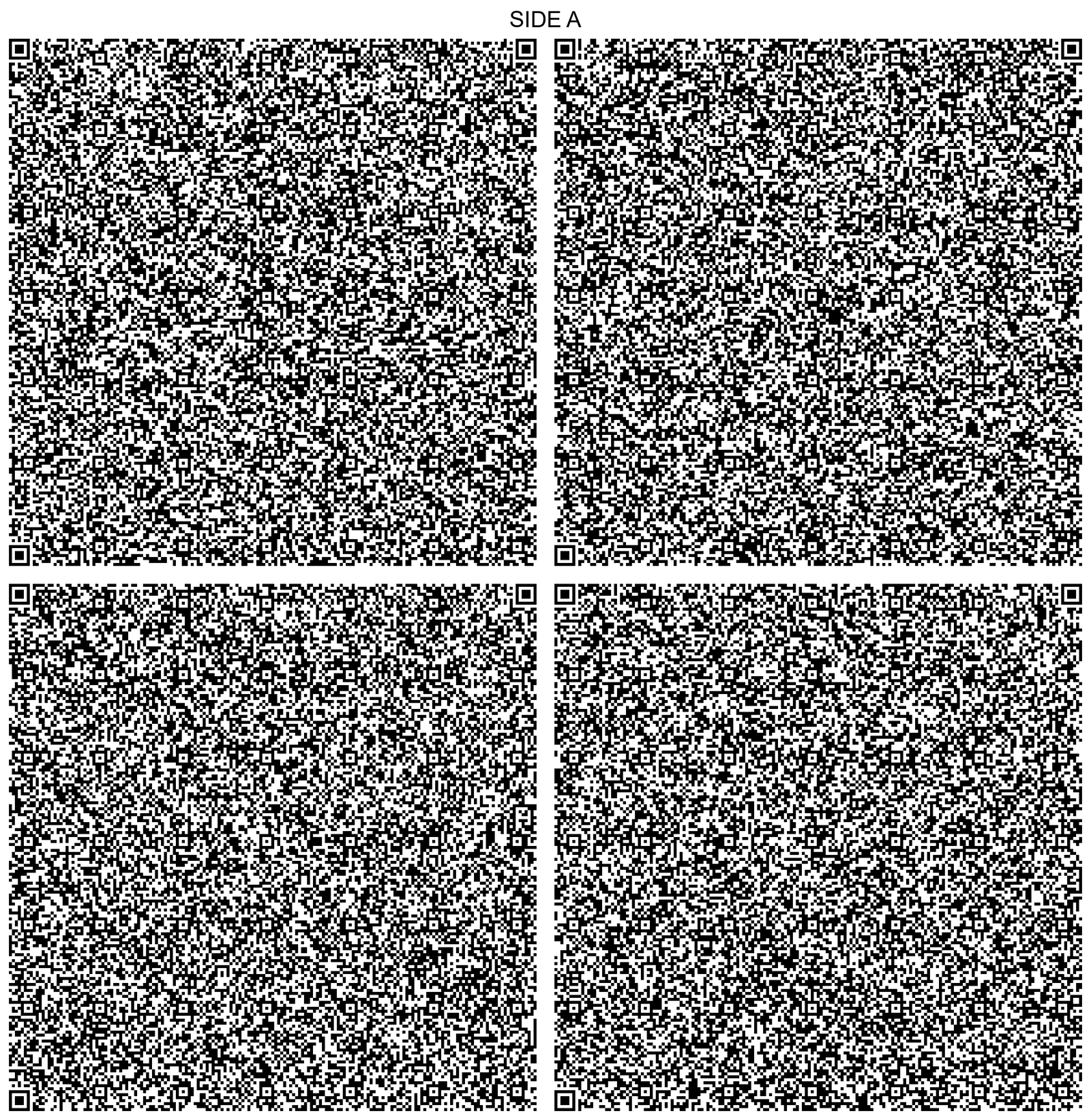
A maker called Makestreme took a two-minute, 2.9 MB song, ran it through Meta's EnCodec neural audio codec, and got it down to roughly 21 KB. Then they printed the result on paper: eight QR codes, four per side, laid out like a cassette. Scan the codes, feed the tokens back into EnCodec's decoder, and the music comes back. (Tom's Hardware, 16 August 2026)
A song. On paper.
We had one question: would a watermark survive that?
So we tried it.
We added one step
We repeated the experiment with a 60-second excerpt of a song, and added one step at the beginning: before anything else, we embedded a DeepMark watermark.
Then the audio made the same trip. EnCodec at 3 kbps, 24 kHz mono. The token stream split across eight QR codes on two "cassette sides", about 3 KB per code, roughly 22 KB in total. Printed. Scanned back. Decoded. The neural decoder reconstructed it into a new waveform. And finally, handed to our detector.
The watermark was still there.
That led us somewhere more interesting than "DeepMark survived another codec."
For a moment there was no audio at all. No file, no waveform, no samples. There was a piece of paper. And when the audio came back, its provenance came back with it.
That is the part that matters.
Listen for yourself
The QR code isn't the hard part
One distinction is worth clarifying.
We did not put an audio watermark inside a QR code. QR codes carry bits, and bits are bits: if they are read back correctly, they can represent anything. In this experiment, they represent the token stream produced by a neural codec. The paper is a delivery mechanism, nothing more.
The destructive part is what the codec does to the audio.
A neural codec doesn't preserve the waveform sample by sample. It reduces the sound to a compact learned representation, a few thousand tokens, and a neural decoder then generates a new waveform from those tokens. The output sounds like the input. It is not the input.
That is exactly the kind of transformation that makes provenance hard:
- The file changes.
- The waveform changes.
- The representation changes completely.
- For a while, the content doesn't exist as playable audio at all.
And after reconstruction, the watermark is still recoverable.
The identity left the signal and came back
This is the idea behind content-bound provenance, and the experiment gives it an unusually visual form.
Metadata can say useful things about a file, but metadata belongs to the container. Strip it, transcode the content, record it through another channel, or express it in a new representation, and the information is gone.
A watermark is different. It lives in the signal itself, and it goes wherever the signal goes, even when the signal temporarily stops being a signal. Tokens. Paper. Ink. A camera. Tokens again. Audio again.
We didn't put provenance in the QR code. We put provenance in the music, and the QR code happened to be one of the places the music passed through.
That was the aha moment for us. The media we create today rarely stays in the form it was generated in. Audio moves through codecs, streaming infrastructure, editing software, phone networks, speakers and microphones, and increasingly through AI models themselves. Provenance that only works while the original file is untouched is going to have a very short life.
But does it actually detect?
A fun demo is one thing; numbers are another. So instead of checking one reconstructed clip and calling it a day, we measured how much of the watermark's payload survives, and how much audio the detector needs to recover it.
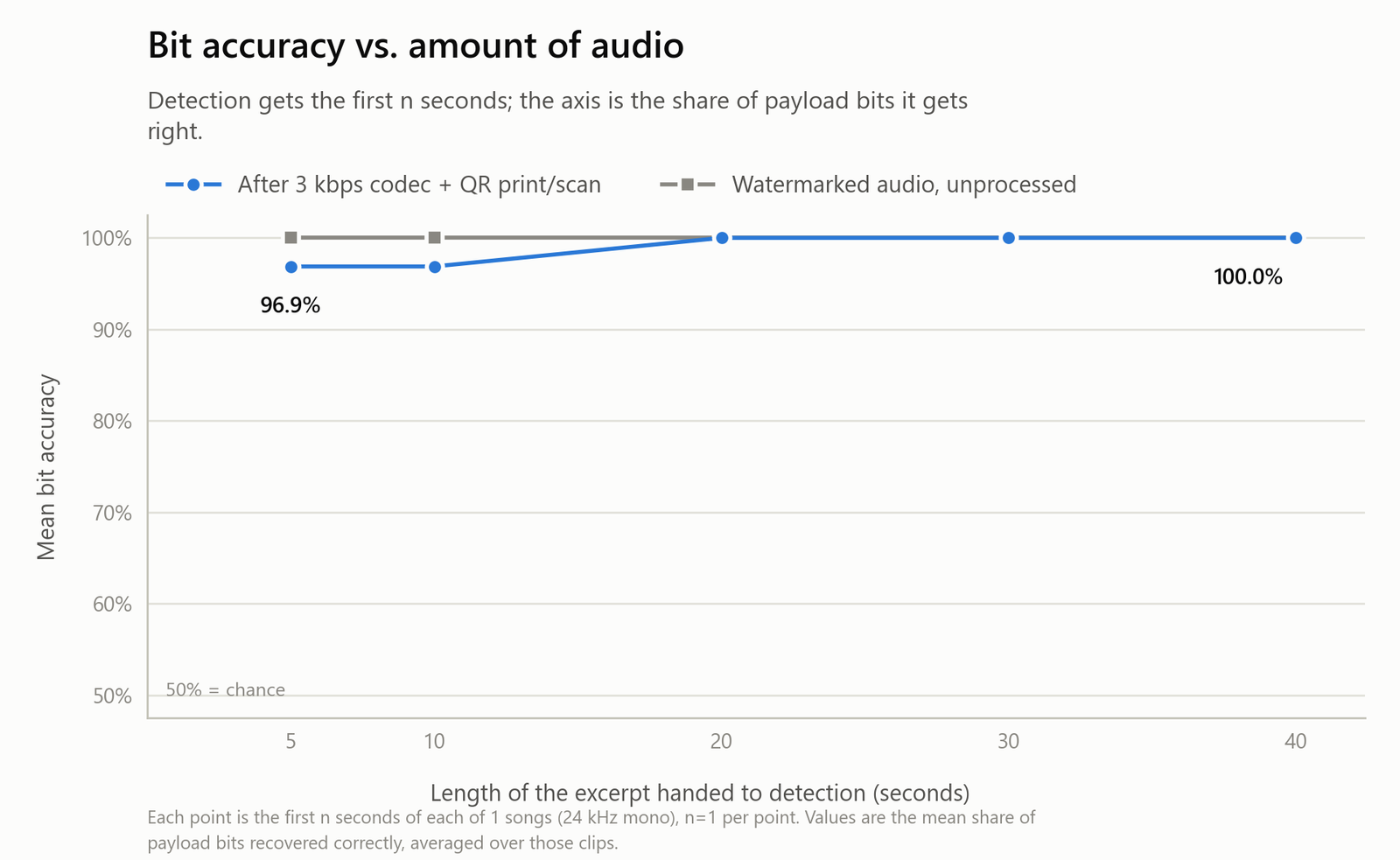
With only the first 5 seconds of the reconstructed audio, the detector recovers 96.9% of the payload bits. The same at 10 seconds. From 20 seconds on, it recovers 100%, matching the unprocessed watermark, which sits at 100% at every length.
Two honest caveats. This is one song and one run, not a benchmark; we ran it because we were curious, and we're sharing it because the result surprised us. And robustness is never absolute. Push any transformation far enough and information is lost, from the watermark and from the content itself. Makestreme's own experiment shows this: at 3 kbps the song holds up; at 1.5 kbps it falls apart. The point isn't to claim immunity. The point is to make provenance survive the transformations that content actually meets in the real world, with a comfortable margin.
Today, eight QR codes. Tomorrow, something less ridiculous.
Printing songs on paper is probably not going to become a major distribution format. We hope.
But that is exactly why we liked this experiment: it exaggerates something that happens to digital media every day. Content is transformed. Compressed, transcoded, edited, streamed, resampled, pushed through phone networks, played through speakers, recorded again, passed through generative models, converted into representations its creator never anticipated. The number of those transformations is only going up.
For provenance, that leaves one requirement: it cannot depend on the content staying untouched.
Today the journey happened to be:
audio → neural codec → tokens → paper → tokens → neural codec → audio
Tomorrow we won't know what sits in the middle. Ideally, we shouldn't have to.
The content may change format. The file may disappear entirely. The proof of where it came from should survive the trip.


Mark what you generate. Prove what you ship.
Compliance you can demonstrate today, and a path to verified AI voice your customers actually trust, both built into the media you already produce.