
Pushing Watermark Resilience to the Edge: A Real-World Torture Test
At DeepMark, we've always believed that watermark robustness isn't something you claim, but rather something you prove. So, watermark robustness isn't defined by how well an algorithm performs in clean laboratory conditions; it is defined by how it behaves in the wild, under the messy transformations that audio typically undergoes. Compression, enhancement, re-encoding, social platform processing, amateur edits, and even casual playback-and-record chains can all introduce distortions that traditional watermarking systems simply can't withstand.
We recently ran an intentionally unfair, aggressively real-world stress test on our latest DNN-based audio watermarking system. The goal was simple: find out how our technology performs when exposed to the kinds of destructive transformations that, without exception, break all DSP-based watermarking techniques.
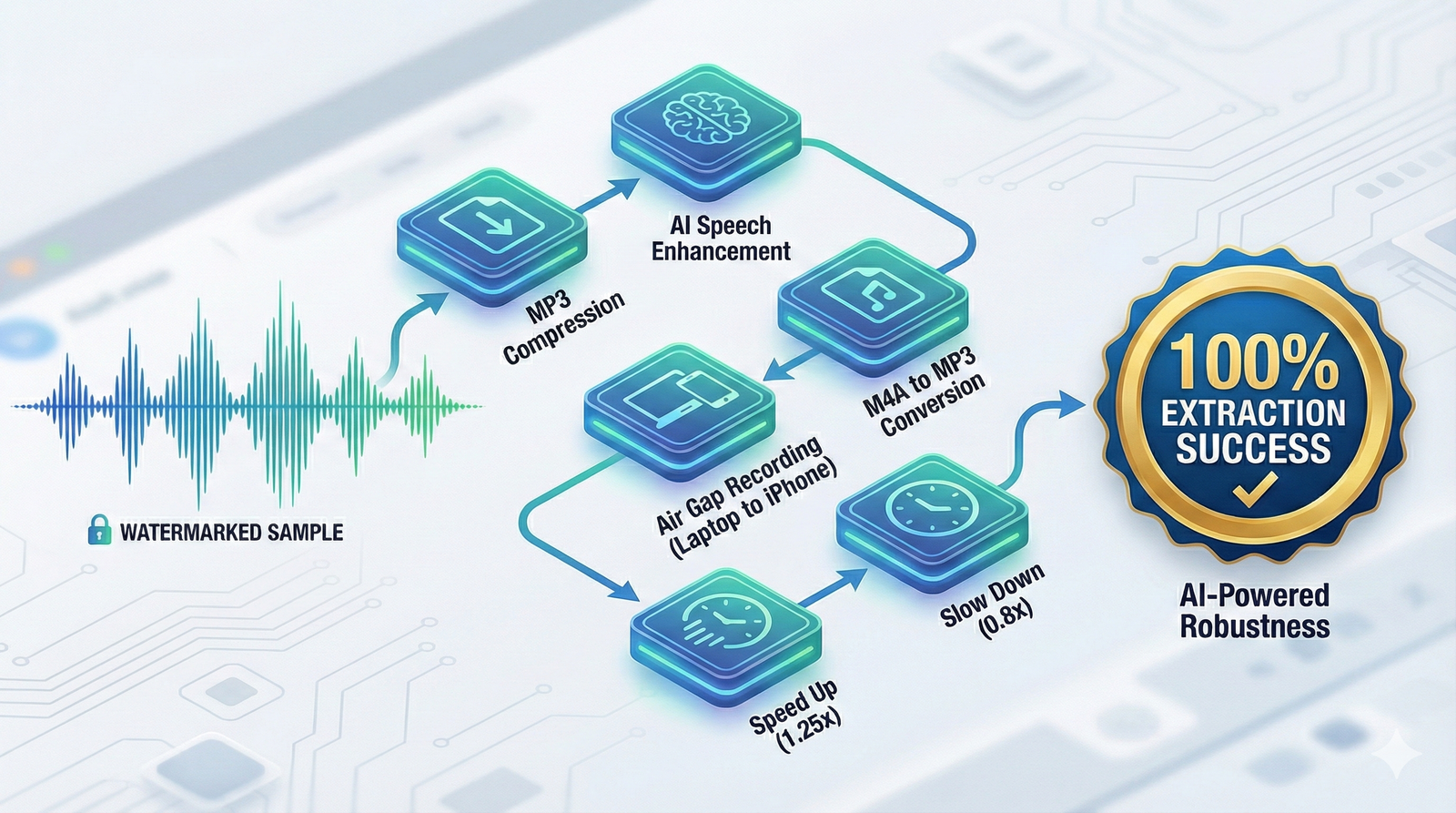
The full attack pipeline is shown below.
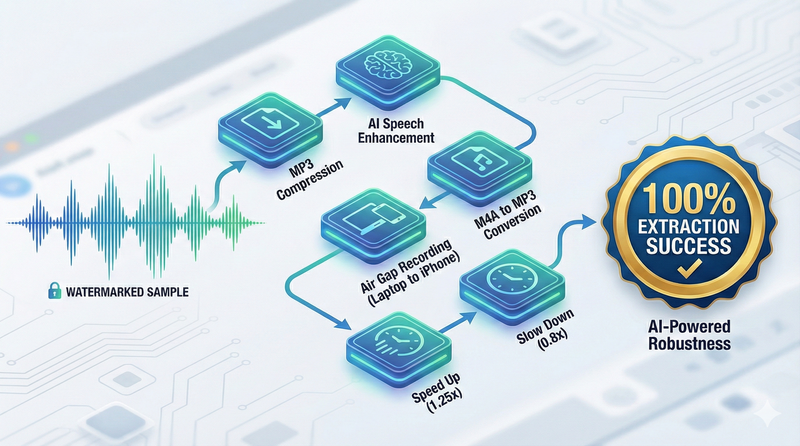
Figure 1: Overview of the audio attack pipeline.
The Chain of Destruction
Even though we didn't set out to give this torture test a dramatic name, the sequence of transformations earned one on its own. Here's the breakdown:
- Watermark embedding in clean speech audio.
- MP3 compression, introducing perceptual distortions.
- AI speech enhancement using the publicly available tool from eMastered (https://emastered.com/ ), which modifies spectral characteristics and removes what a model thinks is "unnecessary noise."
- Analog re-recording: the audio is played through a laptop speaker and captured with an iPhone microphone.*
- Format conversion from M4A → MP3 after the analog capture.
- Time-scaling (speed-up) with a boost factor of 1.25×.
- Time-scaling (slow-down) with a factor of 0.8×.
* This step is exceptionally aggressive: nonlinearities, room acoustics, microphone coloration, and device noise destroy the structure DSP watermarks rely on.
These transformations combine digital degradation, AI-driven spectral modification, analog domain chaos, and temporal warping—precisely the blend of real-world entropy that makes watermark survival exceptionally challenging.
The Outcome: Complete Recovery
Despite everything we threw at it, our detector extracted 100% of the watermark bits. No errors. No drift. No partial recovery. Just a clean, unambiguous decode.
For context, most classical watermarking systems fail after only one of these steps. Surviving all of them sequentially is far beyond the capabilities of handcrafted DSP embeddings.
The difference lies in learning-based embedding. Rather than relying on fixed frequency bands or handcrafted perturbation rules, our neural watermark distributes information across psychoacoustic and temporal patterns that remain stable—even when the signal undergoes severe distortion.
Why This Matters
In today's world, audio doesn't stay still. It travels through messaging apps, editing tools, conferencing software, social media compressors, AI enhancers, cheap speakers, phone microphones, and everything in between. Every hop distorts it a little differently, and by the time the audio reaches its final listener, it has often lived a chaotic life full of transformations.
This is why robustness isn't optional. If a watermark is to provide reliable attribution or provenance, especially in an era where synthetic speech can be generated and shared in seconds, it must hold its ground through real-world abuse, not just controlled lab conditions. Surviving MP3 compression is one thing; surviving AI enhancement, analog re-recording, and compounded time-warping is an entirely different league.
What this experiment showed us is simple but important: learning-based watermarking isn't just incrementally better, it opens the door to a new robustness regime. And that resilience is exactly what the ecosystem needs if watermarking is going to be trusted at scale.



Mark what you generate. Prove what you ship.
Compliance you can demonstrate today, and a path to verified AI voice your customers actually trust, both built into the media you already produce.